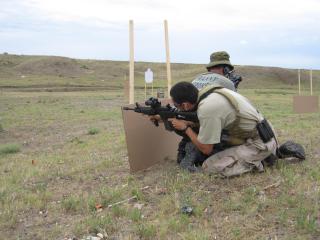
The loop sling easily carries the long-gun, and it can be used as an improvised shooting sling. The M1907 distinguishes itself as a shooting aide, but is also used to carry the rifle. A rifle slung with either of these slings in the conventional fashion over the back is not easy to employ quickly, since the shooter must untangle himself from the rifle and re-orient the rifle before shooting.
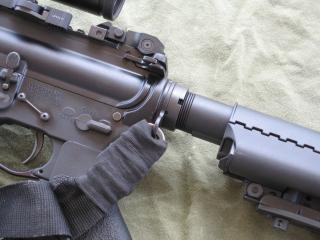
Modern tactical sling provides two basic functions. The first is to allow the rifle to be carried in a ready position, for quick employment. The second function is to secure the rifle during transitions to a secondary weapon, while doing a "hands on" task like handcuffing, or while negotiating obstacles.
Tactical slings for carbines, shotguns, and submachine guns are generally one of three types: single-point, two-point, and three-point. A "single-point" sling is a single loop which goes around the shooter's body, over one and under the other shoulder. It connects to the weapon near the stock to receiver junction. The single-point sling provides minimal support for carrying the
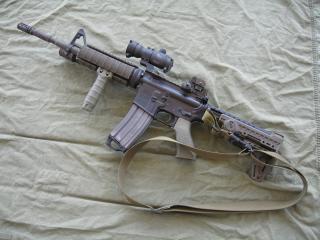
weapon, but provides maximum range of motion when the weapon is in use. A single-point sling allows shooting from any position including from weak-shoulder without the shooter extricating himself from the sling. When dropped during a secondary weapon transition, the long-gun simply hangs from the single connection point. This provides minimal control of the weapon during movement and isn't the best way to hump a rifle over a long distance. The single-point sling merely keeps track of the weapon when it's not in use.
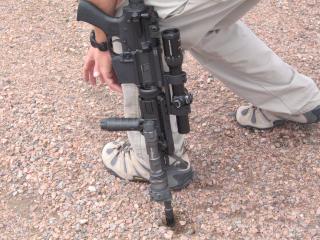
Unlike the other two types of slings, the single-point does not do a good job retaining control of the rifle. While a two- or three-point sling will control the muzzle, a single-point sling does not, and the muzzle will to hit the ground when kneeling, crouching, or doing other low to the ground tasks.
I looked at four single-point slings. The first was from The Wilderness Tactical. It connects to the receiver to stock junction using a flat loop, and has an emergency release buckle which breaks the loop around the shooters body. The second was the Specter Gear MOUT sling. This sling has a one inch loop which connects to a flat mount at the receiver junction and provides more flexibility from the main body loop. It has a release buckle which releases the entire body loop from the one inch loop connected to the weapon.
The next two single-point slings I evaluated use a snap-hook instead of a web loop to connect to the receiver. The Troy CQB One-Point Sling has an approximately six-inch offset strap from the receiver to the body loop. Its
body loop is also padded. This sling provides additional freedom of movement with the weapon, but retains it in position when slung the least. The Blackhawk Industries ZM Single Point Sling also snaps into the receiver mount, but has no offset loop. The distinguishing feature of the Blackhawk ZM sling is that its body loop is partially bungee cord, which can offer additional freedom of movement, but still retains the weapon reasonably well during transitions.The second type of sling is the two-point, which connects to the front and rear of the weapon, similar to the old loop slings. Modern two-point slings generally use sling mounts on the side of the weapon instead of the bottom, to facilitate carry of rifles and carbines which have protruding box magazines. Two-point slings provide more control over the weapon when slung than the single-point, and they can be used in all the carry positions as the original loop slings. The primary limitation of conventional two-point slings is that they are not adjustable on the fly, leaving them either too short to shoot while slung, or too long to use for carry.
Kyle Lamb of Viking Tactics developed the VTAC sling, a two-point which is adjustable on the fly for length. It can be loosened while shooting, and tightened up for carry. Another more recent adjustable two-point sling is the Vickers Combat Applications Sling, sold by Blue Force Gear. It operates similarly to the VTAC sling, but uses a different adjuster and has an emergency release buckle. These modified two-point slings have many of the advantages of both the three-point and single-point slings, but few of the "cons".
These modified two-point slings have another advantage in that they can be attached to the rifle in different places. The rear attachment point can be at the rear of the stock or at the stock to receiver junction; the front attachment point can be near the front sight base or nearer to the receiver. This flexibility allows the shooter to set it up for maximum freedom of movement as well as control of the weapon. When he slings or deploys the weapon, he can
The third type of sling is the three-point sling, which connects to the front and rear of the weapon, and has a slider so the loop around the shooter's body connects to the main loop about halfway back from the sling's forward attachment point. Three-point slings provide more control of the weapon than the other two types, and they allow more carry modes. The primary advantage of the three-point
The three-point sling can also carry the rifle like a back-pack, which is useful when climbing or other activities which require no frontal obstructions.
Another consideration with the three-point sling is that the multiple straps can get hung up on SWAT gear or load-bearing harnesses. In addition, for left-handed shooters, the strap closest to the gun can interfere with an AR-15's ejection port.
I checked out six three-point slings for this review. The first is Giles Tactical Sling made by The Wilderness. It is as simple as a three-point can get, but it gets the job done nicely. For a shooter without special applications, the Giles Tactical Sling will fit the bill at a good price.
Specter Gear, once called CQB Solutions, has made some of the most dramatic improvements in three-point sling design. The first basic improvement is an emergency release buckle (ERB) on their CQB Sling, which untangles the shooter from the main sling loop. The next improvement is in the Cross-Shoulder Transition (CST) Sling. The CST has a slider which allows the shooter to adjust the body loop position on the fly, which allows him to shoot from his weak-side
The SPEC-OPS Brand MAMBA sling is very similar to the Specter Gear CQB Sling, but distinguishes itself with a bungee portion of the body loop at the rear of the sling. The addition of the bungee material is unconventional, but sometimes just a little more mobility is required when trying to clear gear or transition, and the bungee can provide it. Finally, the Blackhawk Industries Swift Sling follows the same basic three-point pattern, but has a buckle for cross-shoulder transitions. Once this buckle is released, it requires two hands to reset and is somewhat awkward.
Which sling is right for you? For patrol or where maximum weapon control is needed, the three-point sling is the best choice. When weapon control is needed but there may be an issue with the sling getting tangled in gear, one of the modified two-point slings is the best choice. If maximum weapon mobility is required or a plate-carrier or load-bearing vest is being used, the single-point sling is the best choice, though the trade-off is less weapon control when slung.
My favorite three-point sling is the Specter Gear SOP. Its wide body loop distributes weapon weight comfortably and the cross-shoulder buckle is easily adjusted with one hand. The Blue Force Gear Vickers Combat Applications Sling is the best two-point sling going. The single-point slings reviewed here all worked well, but the bungee loop in the Blackhawk ZM provided some additional weapon mobility.
| Manufacturer | Model | Type | Quick Release | Special Features | Price* |
| Specter Gear | Close Quarters Battle (CQB) Sling | three-point | optional | $34.45 | |
| Special Operations Patrol Sling | three-point | optional | 1.5" wide strap, shoulder transition release buckle, offset mount loops | $39.25 | |
| Cross Shoulder Transition Sling | three-point | optional | shoulder transition release buckle | $36.75 | |
| MOUT Sling | single-point | yes | $23.50 | ||
| The Wilderness | Giles Tactical Rifle Sling | three-point | optional | $49.95 | |
| Single-Point | single-point | optional | $25.00 | ||
| Troy Industrires | CQB One-Point Sling | single-point | yes | $34.00 | |
| Blackhawk | ZM Single Point Sling | single-point | yes | snap-hook to receiver mount, partial bungee loop for flexibility | $65.95 |
| Swift Sling | three-point | yes | shoulder transition release buckle | $39.95 | |
| SPEC-OPS Brand | MAMBA Sling | three-point | yes | partial bungee loop | $49.95 |
| Master Blaster | two-point | yes | partial bungee loop, length adjustement | $29.95 | |
| Viking Tactics | VTAC sling | two-point | no | adjust length on the fly | $34.95 |
| Blue Force Gear | Vickers Combat Applications Sling | two-point | yes | adjust length on the fly | $49.95 |
| * Slings priced for M16A2 model. | |||||
SOURCES Blackhawk Industries www.blackhawk.com Blue Force Gear www.blueforcegear.com SPEC-OPS Brand www.specopsbrand.com Specter Gear www.spectergear.com Troy Industries www.troyind.com Viking Tactics www.vikingtactics.com The Wilderness Tactical www.thewilderness.com